The Economic Collapse of the Western Roman Empire: Parallels to Modern Fiat

The Monetary Anatomy of an Imperial Superpower
Popular historical memory attributes the fall of the Western Roman Empire to cinematic cataclysms: the dramatic crossing of the Rhine by Germanic tribes, the Visigoth sack of Rome in 410 AD, or the catastrophic defeat at the Battle of Adrianople. While barbarian migrations and military defeats were the immediate instruments of Rome’s political fragmentation, the fundamental rot had set in centuries prior.
The true engine of Roman decline was monetary and economic. Before the Western Empire fractured militarily, it had already destroyed its own economic foundation through chronic currency debasement, runaway inflation, oppressive state confiscation, and the systematic destruction of price discovery.
As modern central banks navigate ballooning sovereign debt, unprecedented balance sheet expansion, and structural currency debasement, the monetary trajectory of the Roman Empire provides a chillingly relevant case study in macroeconomic thermodynamics.
The Denarius: From Sound Money to Silver-Plated Copper
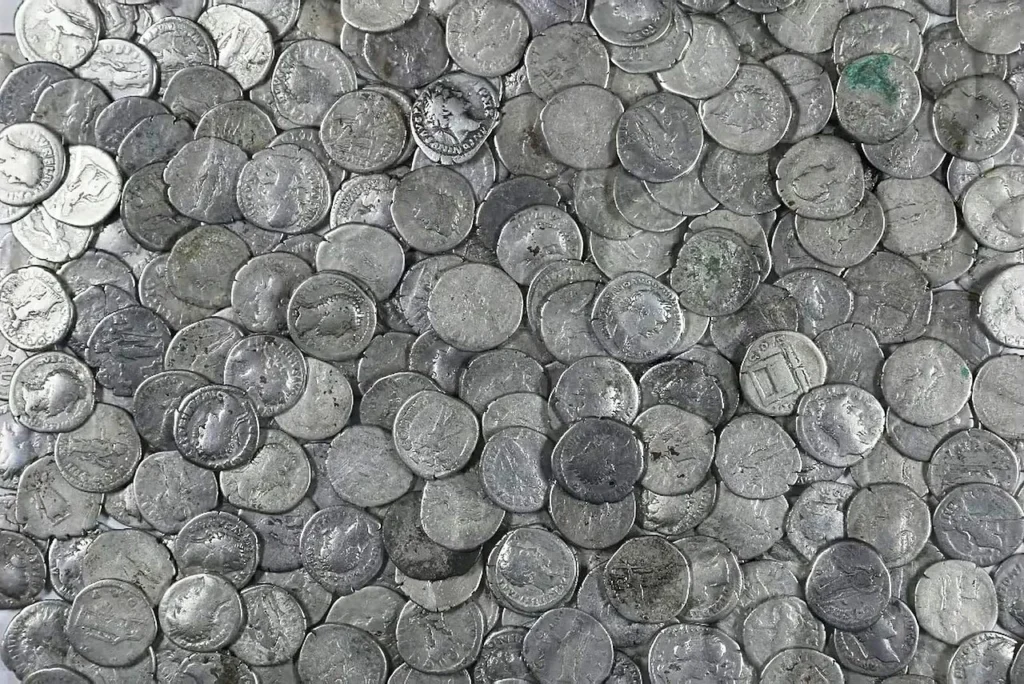
The monetary backbone of the Roman Republic and early Empire was the silver Denarius. Under Emperor Augustus (27 BC – 14 AD), the Denarius was a coin of pristine sound money, containing approximately 3.9 grams of nearly pure silver (95–98% purity). This sound currency supported centuries of Pax Romana, enabling vast commercial trade networks across the Mediterranean Basin.
However, the Roman state faced an escalating fiscal dilemma: a bloated imperial military, massive bureaucratic apparatus, and expansive social subsidies (“bread and circuses”). Unlike modern states, the Roman treasury could not print paper fiat notes or expand digital ledger balances. To pay its legions and balance chronic deficits without raising politically dangerous direct taxes, the state began to secretly debase the coinage.
The trajectory of silver content debasement across three centuries reveals the exponential decay:
- Augustus (27 BC): ~98% silver content.
- Nero (64 AD): Debased to ~90% silver to finance reconstruction after the Great Fire of Rome.
- Trajan (100 AD): Reduced to ~85% silver to finance expanding imperial campaigns.
- Marcus Aurelius (170 AD): Lowered to ~75% silver following the economic disruption of the Antonine Plague.
- Septimius Severus (195 AD): Halved to ~50% silver to fund massive army pay raises.
- Gallienus (260 AD): Plunged to less than 2% silver—the coin was reduced to a copper slug dipped in a microscopic wash of silver that wore off within weeks of circulation.
By the reign of the Barracks Emperors during the Crisis of the Third Century, the Denarius had lost 99% of its purchasing power. Roman merchants quickly recognized the debasement (Gresham’s Law: bad money drives out good). They hoarded old, high-silver Augustus and Trajan coins and refused to accept debased currency except at steep discounts. Commodity prices across the empire soared by hundreds of percent.
Price Controls and the Edict on Maximum Prices (301 AD)
Faced with hyperinflation and soaring cost of living, Emperor Diocletian enacted one of the most infamous economic decrees in world history: the Edict on Maximum Prices (301 AD). Rather than acknowledging that the state’s own monetary debasement had caused the inflation, Diocletian blamed “rampant greed,” merchants, and hoarders.
The Edict established legally mandated price ceilings for over a thousand goods and services—grain, wine, oil, clothing, and labor wages. The penalty for selling above the mandated price was immediate execution.
The economic consequences were predictable and instantaneous:
- Immediate Market Shortages: Producers could not cover their real production costs at the state-mandated price caps. Goods vanished from urban marketplaces overnight.
- Flourishing Black Markets: Trade shifted entirely into illicit underground channels, conducted via barter or old gold coinage.
- Total Economic Paralysis: Rioting and executions followed until the Roman state was forced to abandon the Edict entirely.
The Destruction of the Urban Middle Class and the Rise of Feudalism
The collapse of sound money destroyed the commercial fabric of the empire. Urban merchants, craft guilds, and smallholder farmers—unable to cope with debased currency, price controls, and confiscatory tax collectors—abandoned the cities in droves.
Wealthy aristocratic patricians retreated to massive, fortified rural estates (latifundia). To ensure agricultural continuity, Diocletian and subsequent emperors issued decrees binding workers and their children to their land and professions (the Coloni system). The monetary collapse of Rome effectively dismantled free-market Mediterranean commerce and laid the architectural groundwork for European feudalism and serfdom centuries before the Western Empire officially fell in 476 AD.
The Modern Parallels: Fiat Debasement in the 21st Century
While the mechanics of monetary expansion have evolved from mint debasement furnaces to central bank digital ledgers, the underlying macroeconomic principles remain unalterable:
1. Structural Deficits and Monetization
Just as imperial Rome could not maintain its sprawling borders and military payroll through taxation alone, modern sovereign governments face catastrophic fiscal deficits driven by entitlement liabilities, military spending, and debt servicing costs. In both eras, the state chooses the path of least political resistance: currency debasement (quantitative easing, yield curve control, and balance sheet expansion).
2. The Cantillon Effect
In ancient Rome, the primary beneficiaries of debased money were the legions and imperial contractors who received newly minted coins before prices adjusted across the provinces. In modern economies, the Cantillon Effect ensures that the financial elite, institutional banks, and asset owners receive newly created liquidity first, while working-class wage earners suffer the delayed consequence of compounding real inflation.
3. Scapegoating and Administrative Distortions
When monetary inflation drives consumer prices upward, political leaders routinely mirror Diocletian: blaming “corporate greed,” price gouging, and supply chain operators, while proposing price controls and windfall taxes that inevitably exacerbate supply destruction.
Conclusion
The collapse of the Western Roman Empire was not primarily an act of foreign conquest; it was the inevitable mathematical consequence of monetary suicide. A civilization cannot sustain itself when its sovereign unit of account is turned into a political instrument of fiscal deceit. For the modern economic and technological architect, the lesson of Rome is absolute: wealth is not a number printed on fiat paper or stored on a centralized bank server; real wealth is productive capacity, sound infrastructure, and unmanipulated trade. Ignore the history of monetary debasement, and you are condemned to relive its consequences.